Hardware Architecture to Overcome the IT/OT Barrier: Secure Remote Service for Machine Builders

Plant IT departments legitimately reject unconstrained remote access. By eliminating inbound firewall ports and avoiding the broad subnet exposure of conventional VPNs, secure remote service can be established through hardware-enforced microsegmentation and authenticated brokers.
When plant IT declares that corporate security policies prohibit inbound port forwarding, software features lose their practical utility. The engineering question is clear: How can machine builders deliver rapid remote service while fully respecting the plant’s legitimate security mandates? Eliminating inbound ports, establishing outbound-only P2P encrypted tunnels, enforcing hardware-based network isolation, and requiring operator-controlled key switches provide the foundation to bridge this divide.
The Real Cost of Unplanned Downtime
Siemens’ 2024 “True Cost of Downtime” report reveals a stark operational reality: Unplanned downtime erodes 11 percent of the annual revenue of Fortune Global 500 companies. This represents an annual loss of 1.4 to 1.5 trillion dollars, roughly equivalent to the GDP of Spain. On an hourly basis, downtime costs reach 2.3 million dollars in automotive, 300,000 dollars in heavy manufacturing, and 1 million dollars in oil and gas.
Behind these figures lie two common field scenarios:
- Intellectual Property Exposure: Installing engineering software on customer laptops and transferring raw PLC project archives over screen shares exposes proprietary automation logic, or halts when IT restricts third-party remote desktop utilities.
- Blind Dispatches: Operators struggle to articulate complex machine alarms over the phone. Technicians travel to the facility without accurate diagnostic logs, frequently discovering they brought incorrect spare parts and requiring a second service flight.
Industry estimates show that between 60 and 80 percent of machine stoppages are software or parameter-related and could be resolved remotely if secure access existed.
Why Plant IT Refuses Inbound Access
The recurring friction between automation engineers requesting open ports and IT departments denying them is understandable: IT’s refusal is completely justified.
The Threat of Inbound Ports
An open inbound port listens continuously on the perimeter firewall. Port scanners like Shodan and Censys index newly exposed endpoints in seconds. Direct access to an unpatched PLC or HMI panel presents an easy target, allowing an attacker to breach an entire factory network from a single machine. Both NIST and IEC 62443 designate inbound isolation as a non-negotiable security baseline.
Why VPNs Fall Short
VPN encryption is robust, but traditional VPNs create an excess privilege problem. A VPN places the remote user inside the castle perimeter, granting broad visibility across internal subnets. A vendor engineer attempting to service a packaging line may inadvertently receive route access to manufacturing execution or corporate financial networks. Furthermore, malware present on the technician’s workstation can propagate laterally across the plant floor over the VPN tunnel.
The solution requires flipping the direction of initiation: rather than demanding inbound entry through the firewall, the in-panel hardware initiates a secure connection outward.
Outbound 443 Peer-to-Peer Architecture
Plant firewalls block incoming connections while permitting authorized outbound traffic to designated broker endpoints over TCP 443 (HTTPS). This initiates an outbound encrypted tunnel without opening exposed inbound ports. Establishing communication exclusively over outbound channels aligns with existing corporate security postures.
The architecture operates deterministically:
- The in-panel edge node inside the plant and the remote technician client authenticate against an external broker.
- Once authentication is complete, a P2P encrypted tunnel is established directly between both endpoints.
- The broker server neither inspects nor stores industrial telemetry; its sole function is facilitating the initial cryptographic handshake.
- Plant IT is never asked to open inbound ports. The in-panel device initiates an authorized outbound connection over TCP 443.
Hardware-Based Microsegmentation
Once connected, plant network security must not depend solely on software safeguards; it must be enforced physically at the hardware boundary.
Physical Network Isolation
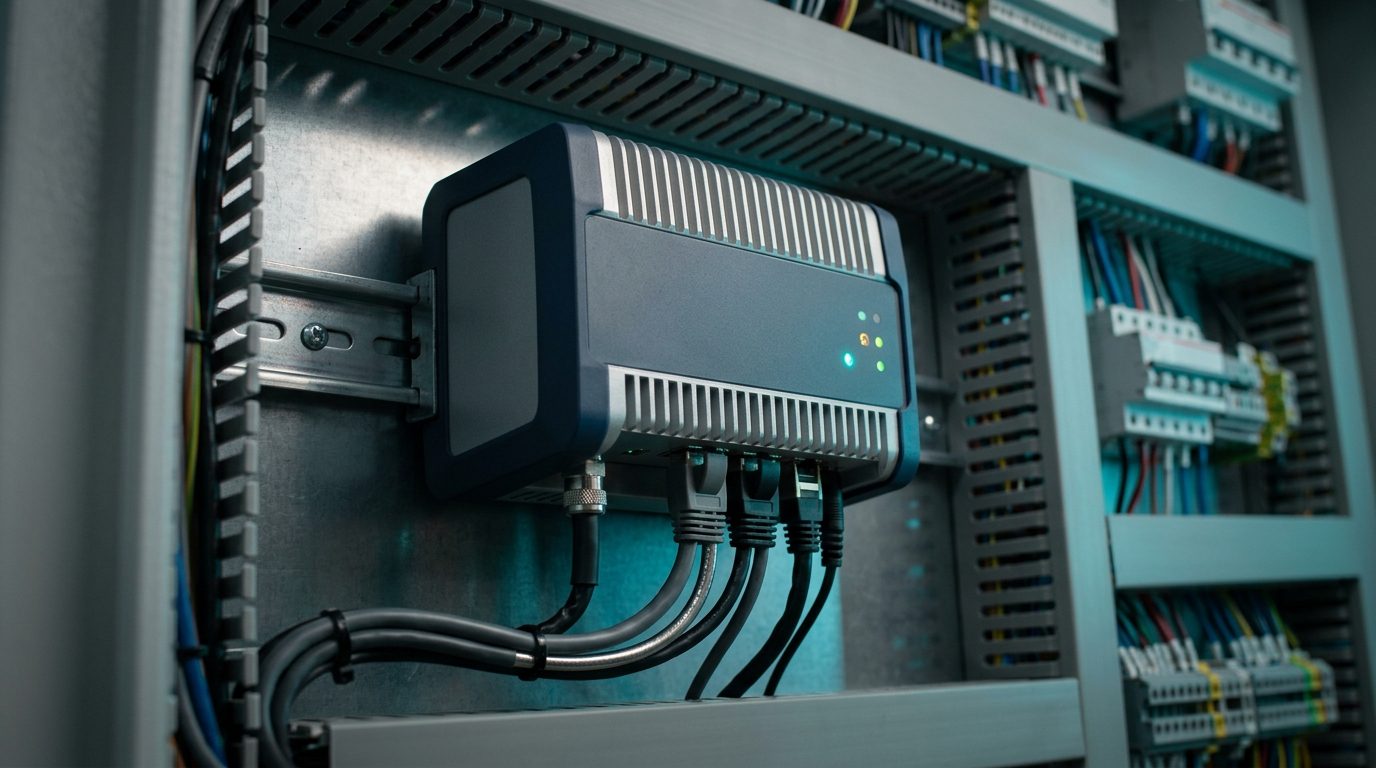
Mounted directly to the DIN rail inside the electrical enclosure, the edge gateway features physically distinct network interfaces:
- WAN Port: Connects to the plant’s corporate network or internet gateway.
- LAN Ports: Connects strictly to the machine’s local PLCs, drives, and HMIs.
The embedded firewall strictly forbids packet routing between the WAN and LAN interfaces.
Blast Radius Containment
Even if a technician’s remote computer is compromised by malware, the tunnel terminates strictly at the local machine LAN. The plant’s broader ERP, SCADA, or adjacent manufacturing lines remain completely isolated. This fulfills the “Zones and Conduits” requirement mandated by IEC 62443-3-2 at the hardware level.
Physical Key Switch for Local Operator Authorization
Leaving industrial machinery accessible remotely 24/7 creates an unnecessary attack surface. During night shifts or normal operating hours, external access should be mechanically disabled.
A physical key switch installed on the machine’s electrical door is wired directly into a digital input on the edge gateway:
- When a malfunction occurs, the on-site operator manually turns the key switch to the service position.
- Only upon receiving this physical contact closure does the edge device initiate the Outbound tunnel.
- The remote engineer establishes the session and conducts diagnostics.
- Once the intervention is concluded, the key is turned off, physically dropping the connection.
Because local physical activation is mandatory, software-based bypass is impossible. Furthermore, during remote parameter adjustments on heavy machinery like hydraulic presses or high-speed conveyors, having an operator present is vital for occupational safety.
Granular Access Control and Return on Investment
Access governance must enforce strict administrative boundaries:
- Central OEM engineering maintains fleet-wide diagnostic authority.
- Regional support units connect only to domestic machines.
- Local dealers inspect only their assigned customer accounts.
- Cryptographic keys reside inside physical USB security dongles, eliminating credential theft risks.
Financial and Operational Impact:
- Mean Time to Repair: Reducing diagnosis delays from several days to under 15 minutes.
- Travel Budget Reduction: Slashing international service flights, hotels, and on-site technician hours by 80 to 95 percent.
- Predictable TCO: Replacing recurring monthly third-party software licensing with an in-panel, one-time hardware investment.
Field Case Study
In an industrial reference deployment, a manufacturer exporting across Europe and the Middle East implemented this architecture across 45 production machines in 8 countries:
- Resolving alarms in Germany from the Istanbul engineering center within 15 minutes.
- Reducing international travel expenditure by 85 percent.
- Retaining full intellectual property without deploying source code to customer laptops.
- Enforcing regional dealer permissions seamlessly.
Conclusion
The IT/OT divide is real, but entirely manageable. A sustainable remote service strategy rests on five core engineering principles:
- Zero inbound ports, relying exclusively on Outbound 443 P2P encrypted tunnels.
- Hardware-enforced WAN/LAN microsegmentation compliant with IEC 62443.
- Physical key switch integration for operator-authorized on-demand access.
- Granular role-based authorization to safeguard proprietary know-how.
- Treating remote access not merely as a desktop tool, but as an in-panel hardware architecture that establishes ongoing service revenue.
📚 References
Siemens (2024). The True Cost of Downtime Report. Senseye & Siemens.
IEC 62443-3-2 (2020). Security for Industrial Automation and Control Systems — Part 3-2: Security Risk Assessment for System Design. International Electrotechnical Commission.
IEC 62443-3-3 (2018). Security for Industrial Automation and Control Systems — Part 3-3: System Security Requirements and Security Levels. International Electrotechnical Commission.
Stouffer, K., Pease, M., Tang, C., Zimmerman, T., Pillitteri, V., & Lightman, S. (2023). NIST SP 800-82 Rev. 3: Guide to Operational Technology (OT) Security. National Institute of Standards and Technology.
📋 Related Links
📂 Secure Remote Service for Machine Builders: MCA World Fair 2026 Panel Presentation
🔗 Dark Data in the Field: Turning Factory Data into Value with IIoT Infrastructure