The Line Between R&D and Manufacturing: Repeatability and Productization

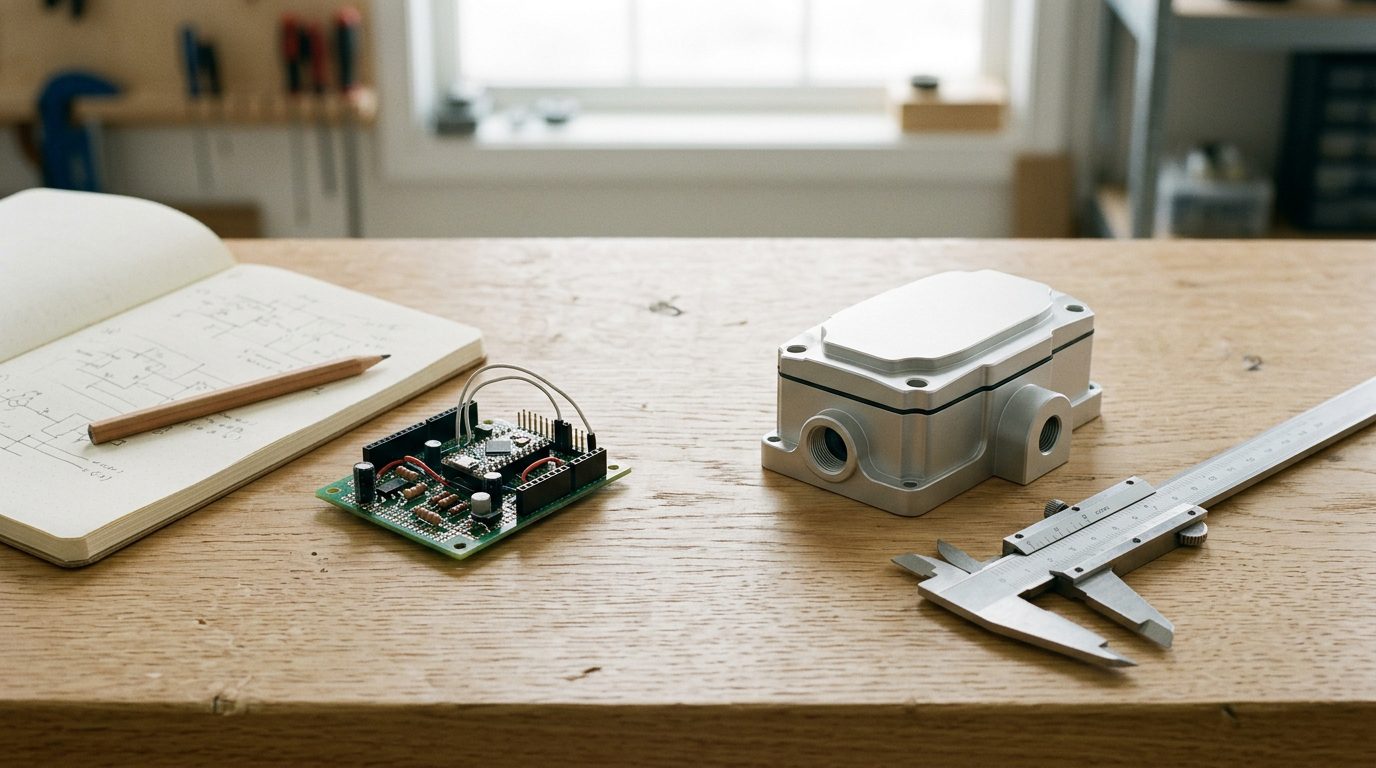
R&D proves technical feasibility; manufacturing delivers reliable repeatability within defined quality tolerances.
There is a profound engineering gap between making a prototype work in a lab and achieving consistent, reliable repeatability across thousands of units in the field. Shipping hand-soldered, one-off calibrated hardware directly to customers locks development teams into permanent service fire drills. Establishing a disciplined handover protocol where R&D does not decide product readiness alone, but collaborates with quality, manufacturing, and service, is the foundation of true productization.
The Farm to Table Illusion
“Straight from R&D to your project” sounds like a fresh, honest, and appealing promise. It markets well, much like the “farm to table” narrative in food. Yet in the industrial world, this shortcut skips critical infrastructure: the kitchen, the standardized recipe, and independent quality control.
R&D proves feasibility; manufacturing delivers reliable repeatability within defined quality tolerances. That distinction is not a slogan; it is the discipline of engineering repeatability.
Prototype Comfort and the Eighth Month in the Field
Everything looks brilliant during the initial prototype phase. You have a hand-soldered electronic circuit board, a fine-tuned one-off calibration completed under laboratory conditions, firmware with no tracked release version, and an unversioned mechanical drawing. There is no doubt that the board runs smoothly on that workbench on that day.
However, when that hardware suddenly fails eight months later in an industrial plant, critical answers are missing:
- Which firmware revision was actually flashed onto this unit?
- Which factory acceptance criteria did it satisfy before dispatch?
- Which supplier batch did its critical semiconductors originate from?
Without a standardized baseline for comparison, root cause analysis is impossible. You cannot systematically fix a device when you cannot isolate why it halted; you can only apply reactive patches.
The Engineer Chained to the Product
The disruption does not stop with technical downtime; the real organizational crisis follows. Every incomplete hardware build pushed into production becomes permanently tethered to the R&D engineer who designed it:
- Field service technicians cannot troubleshoot it and escalate directly to R&D.
- Sales representatives cannot answer technical inquiries and pull the engineer into customer meetings.
- The customer insists on speaking only with the specific individual who laid out the PCB.
Consequently, high-value engineering capacity that should be designing future roadmap technologies is consumed by emergency service firefighting. Worse still, when sales begins selling the same unstandardized hardware to subsequent clients under the assumption that “it already works”, the company’s operational throughput suffers severe disruption.
Decision Authority and the Four Seats at the Table
This failure stems not from a lack of technical expertise within R&D, but from misplaced decision authority within the organization.
R&D must never decide product release readiness in isolation. A product handover cannot be finalized without quality, manufacturing, and after-sales service sharing the same table. The division of roles is clear:
- R&D: “This design works theoretically and functions on the prototype.”
- Manufacturing: “This design can be assembled repeatedly within specified tolerances on the line.”
- Quality: “This unit complies with every documented acceptance criterion without exception.”
- Service: “This system can be monitored, maintained, and modularly repaired in the field.”
Distinguishing a Pilot from a Production Release
Does this imply that deploying hardware to the field early is inherently flawed? Absolutely not.
Pilots and controlled field trials are essential engineering milestones. However, a pilot must be explicitly structured as a pilot:
- Its scope and operational duration are strictly bounded.
- The customer understands and acknowledges the experimental validation context.
- Telemetry and field performance are continuously tracked.
- The organization provides no premature commitment to unconstrained series production.
Deploying early to learn is not the error. The error is shipping a prototype prematurely and labeling it a finished product.
📚 References
Ulrich, K. T., & Eppinger, S. D. (2015). Product Design and Development. McGraw-Hill Education.
Boothroyd, G., Dewhurst, P., & Knight, W. A. (2010). Product Design for Manufacture and Assembly. CRC Press.
Cooper, R. G. (2017). Winning at New Products: Creating Value Through Innovation. Basic Books.
📋 Related Links
🌐 LinkedIn Post: R&D vs. Manufacturing: Repeatability and Productization
🔗 Operational Incentives: Why Companies Lose Money When Everyone Hits Their Targets: The Flaw in KPI Design
📄 Quality & Testing: Is the Product Defective, or the Measurement System? Verifying Test Setups
📂 Leadership & Governance: Using the Methodology vs Being Used by It: Principles Over Dogma