Integrating Wind Energy into the Tekirdağ–Çanakkale Railway Corridor

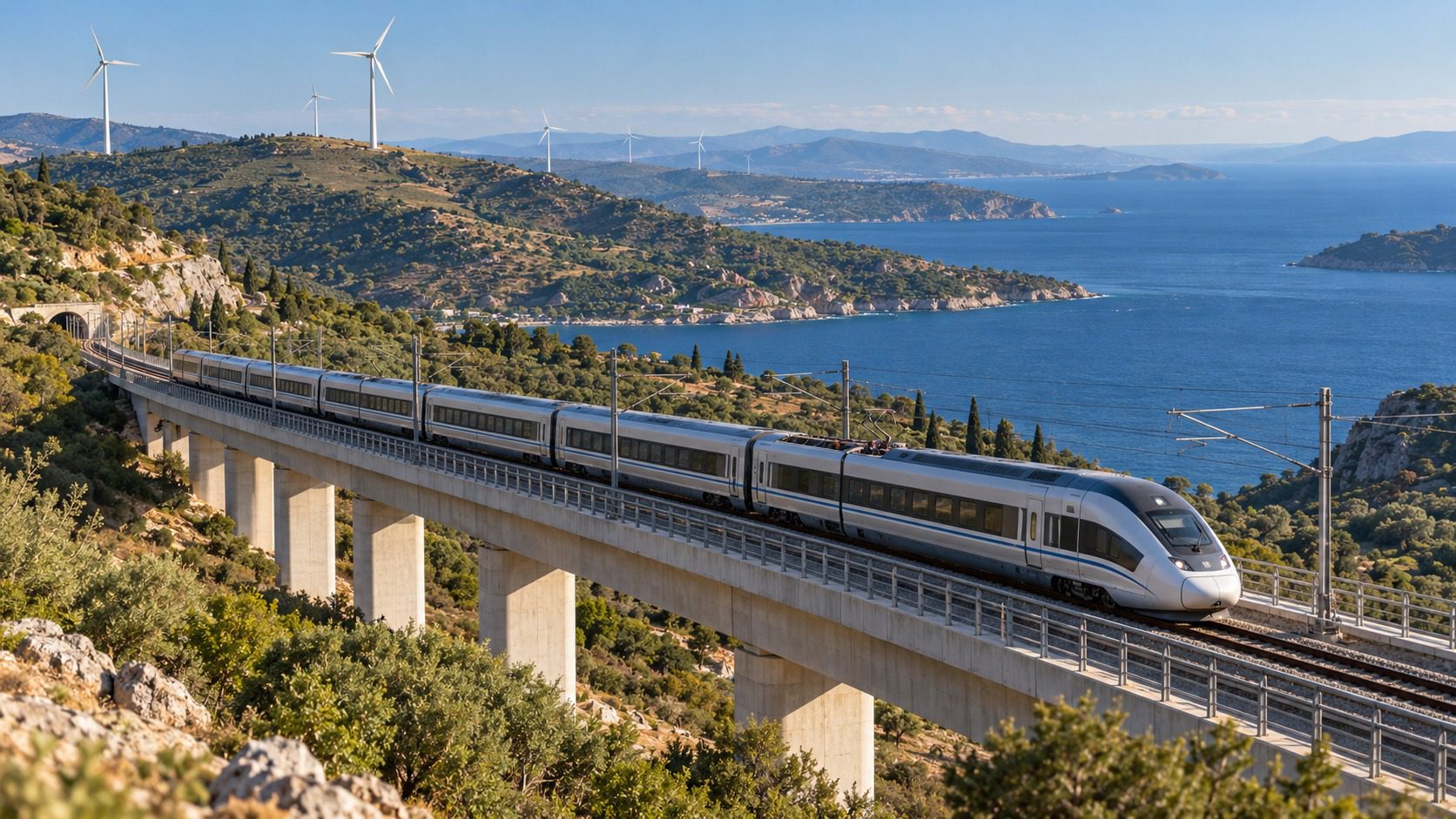
Across the proposed 200 km Tekirdağ to Çanakkale railway corridor, we demonstrated that 79 percent of the annual 247 GWh traction energy demand can be supplied on-site using regional wind potential and hybrid storage.
To relieve the freight bottlenecks across Istanbul and the Marmaray tunnel, we modeled an alternative 200 km electrified railway corridor connecting Tekirdağ and Çanakkale. In this research conducted at ITU Rail Systems Laboratory and published in Railway Engineering Journal, we analyzed how to supply the line’s 246.4 GWh annual traction electricity demand locally by integrating regional wind resources with hybrid energy storage systems.
Project Overview
| Parameter | Value |
|---|---|
| Publication Type | Peer-Reviewed Research Article |
| Journal | Demiryolu Mühendisliği (Railway Engineering), Year: 2026, Issue: 24 |
| Article Number | 1970983 |
| DOI Link | 10.47072/demiryolu.1970983 |
| Research Team | İbrahim Can Kolotoğlu, Serhat Boynukalın, Mehmet Turan Söylemez, Muhammet Işık, Taha Yüksel |
| Institution | Istanbul Technical University (ITU Rail Systems Laboratory) |
| Proposed Corridor | Tekirdağ – Malkara – Keşan – Gelibolu – Çanakkale (200 km) |
| Key Result | 79.2% Traction Demand Met Through On-Site Wind and Hybrid Storage |
| Publication Date | July 2, 2026 |
Why We Targeted the Tekirdağ and Çanakkale Corridor
Eurasian freight volumes moving along the Middle Corridor are expanding rapidly. In Turkey, because international freight relies almost exclusively on the Istanbul Strait and the Marmaray subsea tunnel, capacity has hit an acute operational bottleneck.
To create a strategic bypass southwest of the Sea of Marmara, we designed an alternative 200 km rail route. Starting from Tekirdağ, the modeled alignment crosses Malkara and Keşan toward the Gallipoli Peninsula, traverses the Dardanelles Strait along the 1915 Çanakkale Bridge axis, and connects into Lapseki and Çanakkale.
Our primary goal was not merely drafting an alignment, but evaluating whether this heavy energy consumer could operate independently of utility grid stress by tapping the exceptional wind resources of Çanakkale and Southern Marmara.
How We Calculated Traction Energy Demand
We simulated railway electricity consumption under a realistic operational schedule:
- Traffic Schedule: Modeled 50 heavy freight trains (1500 to 2000 gross tons each) and 50 regional electric multiple-unit (EMU) passenger trains daily in both directions.
- Specific Consumption: Assigned 50 kWh/train-km for freight and 17.5 kWh/train-km for passenger rolling stock.
- Gross Demand: Established a total annual gross traction electricity requirement of 246.4 GWh across the 200 km corridor (daily average of 675 MWh).
- Regenerative Braking Recovery: Modeling fleet-wide braking energy demonstrated a 20 percent gross energy recovery, netting approximately 49.3 GWh per year back into the traction loop.
How We Analyzed the Regional Wind Resource
Using the Turkish Wind Energy Potential Atlas (REPA) and the Global Wind Atlas, we modeled wind regimes across critical stations along the corridor at 50 m and 80 m hub heights using two-parameter Weibull probability distributions.
The Bababurnu station exhibited a standout wind resource profile:
- Mean annual wind speed of 7.2 m/s at 50 m (scaling to 7.69 m/s at an 80 m hub height).
- Mean annual wind power density of 257 W/m².
- Seasonal Complementarity: Crucially, wind power density spikes to 374 W/m² during winter months. This seasonal behavior provides a vital counterweight to solar PV, delivering peak generation precisely when solar output drops, thereby sustaining steady rail traction loads without seasonal interruption.
How We Dimensioned Generation and Hybrid Storage
We dimensioned a 70 MW utility-scale wind plant (14 onshore turbines rated at 5 MW each). Factoring in wake and electrical losses, the net capacity factor was determined at 34 percent, generating 208.5 GWh of net electricity annually.
Because wind generation is fluctuating and train motion creates sharp transient power spikes, we integrated a wayside two-tier Hybrid Energy Storage System (HESS) coupled to traction substations via a shared DC link:
- Li-Ion Battery Bank (50 MWh / 25 MW): Allocated for energy shifting and absorbing hourly supply-demand imbalances (90 percent round-trip efficiency).
- Supercapacitor Bank (0.2 MWh / 40 MW): Absorbs high-rate acceleration peaks and captures regenerative braking pulses without battery degradation (95 percent round-trip efficiency).
This hybrid architecture pushed the direct matching factor of wind generation to 70 percent. When combined with regenerative braking, 79.2 percent of the corridor’s total traction requirement is satisfied by on-site clean energy.
Techno-Economic Findings and Carbon Mitigation
Our techno-economic assessment confirmed the project’s financial viability:
- Total Capital Investment (CAPEX): Approximately 115 million USD, including wind turbines (91 M$), Li-ion batteries (12.5 M$), supercapacitors (2 M$), and grid balance of plant (9.1 M$).
- Avoided Utility Electricity Cost: Yields roughly 16.6 million USD in annual utility bill savings under prevailing industrial tariffs.
- Payback: Factoring in annual operating and maintenance expenses of 2.6 million USD, the model yielded a simple net payback period of 8.2 years (6.9 years gross).
- Decarbonization Impact: Clean generation eliminates between 93,700 and 100,100 tons of CO2 emissions annually compared to grid power.
This study demonstrates that railway electrification should not remain a passive utility consumer, but can serve as a catalyst for large-scale regional renewable energy integration.
📥 Downloads
📄 Full Research Paper (PDF): Demiryolu Mühendisliği Journal Official Paper (857 KB, Open Access)
📚 References
Kolotoğlu, İ. C., Boynukalın, S., Söylemez, M. T., Işık, M. and Yüksel, T. (2026). “Tekirdağ ve Çanakkale Bölgesi için Raylı Sistemlerin Rüzgar Enerjisi ile Entegrasyonu”. Demiryolu Mühendisliği, Issue: 24, Article No: 1970983. DOI: 10.47072/demiryolu.1970983.
📋 Related Links
🔗 DergiPark Official Article Page and DOI
📂 Portfolio: Projects and Systems Integration
📄 Fieldbus Integration in Safety-Critical HMI Systems (ITU Project)
Last updated: July 2026 | Version: 1.1