Distillation, Sovereignty, and Rational AI Strategy: Reading the Map Without Entering the Frontier Race

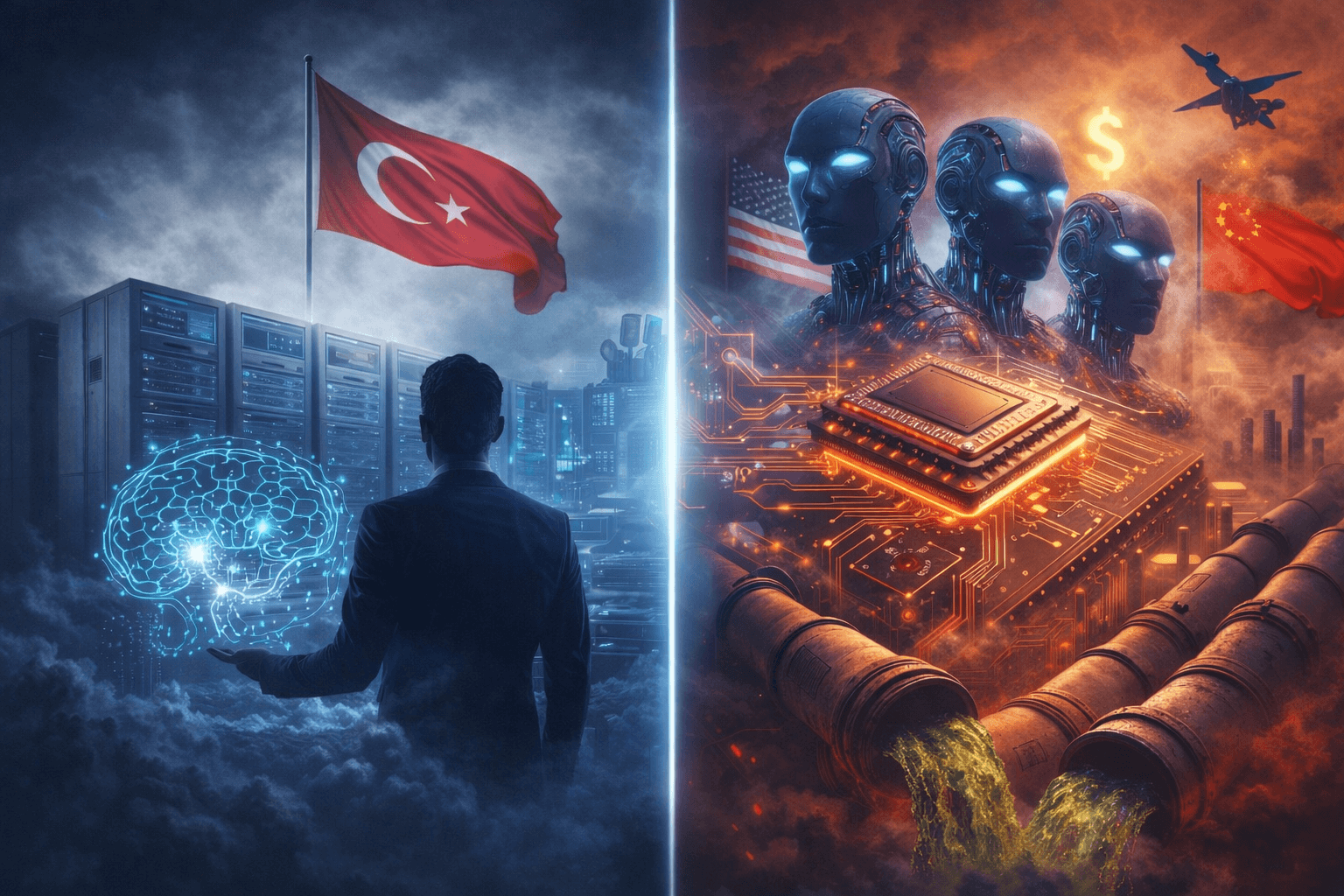
The global competition in artificial intelligence is largely debated through the rhetoric of “developing your own super model.” However, developing a frontier model is a race that demands massive capital, infrastructure, and state support. This article analyzes the technical reality of model distillation, the double standard embedded in major providers’ complaints, the fragile hope-driven economics of state-backed frontier races, and the rational positioning strategy for mid-scale economies like Türkiye. The core argument: sovereignty is not about building the largest model — it is about controlling the most critical data.
Key Takeaways
- Model distillation is mathematically inevitable; any system exposed via API can be approximately reproduced
- Developing frontier models is a race sustained by strategic state support, not free-market dynamics
- Major providers’ distillation complaints contradict the legal ambiguity surrounding their own training data sources
- The rational strategy for countries like Türkiye is not to become a frontier producer, but to build a balance of controlled dependency and local capacity
What Is Distillation and Why Is Everyone Angry?
Model distillation is a straightforward concept in the technical literature: training a smaller model (student) using the knowledge structure of a larger model (teacher). Formalized by Hinton et al. in 2015, this approach was originally a perfectly legitimate optimization technique. Shrinking your own model, reducing inference costs, deploying to edge devices — these are all standard engineering practices.
The concept has taken on an entirely different meaning over the past two years.
When Anthropic accused DeepSeek and several Chinese laboratories of conducting industrial-scale distillation attacks, a technical term was suddenly transformed into a geopolitical weapon. OpenAI’s Sam Altman had voiced similar complaints earlier. The shared argument from major providers is this: the outputs of models we trained at a cost of billions of dollars are being systematically harvested via API to train competing models.
The technical reality both supports and undermines this complaint.
The supporting side: Paying for API access covers the model’s inference cost. It does not cover the right to reproduce the model’s internal structure, training data, or architecture. Major providers’ API terms of service make this distinction explicitly: “You may not use outputs to train your own models.” This is a contractual clause, and it is legally binding.
The undermining side: These same companies, when training their own models, have largely used open internet content — newspapers, blogs, academic papers, forums — without permission. robots.txt and similar bot-blocking files are a technical courtesy protocol, not a legal barrier. Compliance is optional. And many major providers have chosen not to comply. The result: while saying “don’t train models with our outputs,” they themselves have trained models with others’ content. This double standard seriously muddies the legal and ethical debate.
So if the issue is this gray, why is there so much anger?
Because the companies’ complaints are not a technical security report. Look at the word choices: “industrial-scale,” “fraudulent accounts,” “military, intelligence, surveillance,” “growing in intensity.” This is a strategic positioning text designed to create regulatory pressure, frame the issue geopolitically, and consolidate investor confidence. It would be a mistake to see this as a simple outburst of anger.
The underlying mathematical reality remains unchanged: if a model can be sufficiently queried via API, its input-output behavior can be approximately learned. This is a fundamental principle of learning theory. Is it legitimate? Not according to the contract. Can it be technically prevented? Practically, no.
What Is Lost and What Is Gained in Distillation?
The appeal of distillation is clear: compared to the billions of dollars required for frontier model training, you can produce a functional model with much less capital and in a shorter timeframe. But “functional” and “equivalent” are not the same thing.
A distilled model does not receive the original model’s weights. It does not receive its internal representation space. It does not receive the training data. It only approximates input-output behavior. Inevitable losses occur during this approximation:
- Error rates increase in edge cases
- Safety filters sometimes cannot be copied or are lost entirely
- Long-context reasoning may weaken
- Generalization capacity decreases
This is like observing a person, learning to predict their reactions, but ultimately being unable to read their mind or understand how they think. However, if a sufficiently large volume of data is generated, especially in specific task domains, the loss becomes negligible. You don’t need frontier-level capacity for a legal document summarization model or a customer service chatbot. Being “good enough” is more than sufficient for most commercial applications.
This brings up an analogy that makes many people uncomfortable: knockoff products. A knockoff product is never an exact copy of the original either. It is generally lower quality. But it tries to approximate the same function and appearance as the original. It caters to a market segment that prioritizes price-to-performance ratio. And it gains competitive advantage by carrying the original product’s R&D costs down to near zero. Model distillation is exactly this: approximately copying the original’s function, bypassing R&D investment, and entering the market with a cost advantage.
The difference is this: in physical products, the design is reverse-engineered; in model distillation, the behavior function is mathematically learned. The result is the same: the original producer’s return on investment gets suppressed.
This is why major firms view distillation not only as a technical threat but as a strategic one as well. And when viewed from their own perspective, one could argue they are justified.
The Frontier Race: A State Project Financed by Hope
Frontier model training cannot be explained by free-market dynamics or startup economics.
The numbers are plain: massive GPU clusters, hundreds of millions of dollars in energy bills, thousands of researchers, years-long training cycles. This scale does not fit the classical startup economy. When you look at all the actors at the center of this race — OpenAI, Anthropic, Google DeepMind, Microsoft — all of them are positioned within ecosystems that are directly or indirectly state-supported.
This structure resembles a space program, nuclear research, or semiconductor fabrication investment far more than a free-market game. In other words, it is a strategic infrastructure investment. So why are states channeling this much capital into this domain?
The official justifications are familiar: military superiority, cybersecurity, intelligence capacity, economic competition, geopolitical balance. All legitimate strategic concerns. But I believe that what actually legitimizes the scale of these investments is not concrete returns but rather hope. A grand expectation that artificial intelligence will be a transformative technology — fundamentally changing the economy, defense, and scientific research. And this expectation has not yet been fully proven.
Since GPT-3’s release in 2020, the revenue model for continuously increasing compute investments is still unclear. A balance that makes these models commercially sustainable has not yet been established. States continue their support despite this because rival states are also investing — and the cost of leaving the race appears greater than the cost of staying in it. This presents itself more as a security dilemma than a rational calculation.
History has shown us similar cycles. The Cold War space race pushed both sides beyond their economic limits. Nuclear energy promised energy “so cheap it would eliminate the electricity meter” in the 1950s — that promise never materialized, but investments continued for decades. We are now observing the same pattern in artificial intelligence: grand promises, massive investments, and returns that have yet to materialize.
This does not mean artificial intelligence is useless. Its concrete value in very specific domains — protein folding, image analysis, code generation — is indisputable. It is also clear that it is a technology that makes our lives easier, cheap for us personally but expensive for the world at large. But there is a wide gap between the narrative that “general AI will transform everything” and today’s reality. And this gap is being filled not by the magnitude of investments, but by the magnitude of hopes.
If at some point hope proves insufficient against mathematics — that is, when public cost exceeds perceived strategic benefit — the support mechanism breaks. And at that point, structures sustained by state support will collapse; only those generating real commercial value will remain.
At a likely equilibrium and saturation point, I consider it probable that 3-5 frontier model providers will sustain their existence with state-backed compute infrastructure, while the rest become integrators and fine-tuners. This resembles the current structure of the semiconductor industry.
Building Your Own Frontier Model: Prestige Project or Strategic Investment?
At this point, the question turns to nation-states like Türkiye: should we develop our own frontier model?
Frankly, the conditions required to produce a frontier model — tens of thousands of top-tier GPUs, uninterrupted compute, large and clean data pools, a strong research ecosystem, chip supply security — are currently concentrated primarily along the US-China axis. The problem is not intelligence; it is capital intensity and infrastructure scale.
There are domestically trained models from scratch. Examples like Kumru are valuable as technical achievements, but these models are low-parameter and targeted at specific niches. The scale difference compared to a general-purpose frontier model is enormous. And more importantly: such projects generally remain as academic prestige, national symbols, or technology showcases. I do not think their transition to widespread commercial use is realistic under current resource and infrastructure conditions.
What the rhetoric of “we are developing our own super AI” most often corresponds to is this: political messaging, public motivation, and a technology showcase. The real competitive arena is usually not in model parameters but in data infrastructure, application layer, integration capability, and security certification.
Not every small or mid-scale state needs a frontier model. But being entirely dependent on external sources is also a strategic weakness. The real question is not “who builds the biggest model?” but rather “with which model infrastructure and under whose control do we make our most critical decisions?”
Rational Positioning: Where to Stand, What to Use?
Here is where things get serious. Once it is accepted that entering the frontier race is pointless but being trapped entirely in a wrapper economy creates fragility, a rational middle path remains.
Open Models and the Leverage Effect of Local Data
China’s path is instructive here. Companies like DeepSeek focused on producing smaller but compute-efficient models rather than directly competing with the frontier. When you play the cost-performance ratio, approaching frontier capacity becomes possible. If we think in terms of the Pareto principle, the value of this move becomes a bit clearer.
The most rational version for Türkiye: taking strong base models like Meta’s open-weight models, strengthening them with domain-specific local data, optimizing for Turkish, and producing solutions for vertical sectors. This is not copying; it is cost optimization. And value is created not in model parameters but in domain knowledge.
The Wrapper Economy Should Not Be Underestimated
The value chain can be divided into three layers: compute owners, foundation model developers, and the application–integration layer. In the long run, the most stable cash flow is generally found in the third layer. Why? Because it solves direct customer problems, embeds domain knowledge, and retains its value even if the underlying model changes. While there is an upper bound to the capacity of compute-backed model producers, high-quality solutions built on top of them can scale to multi-billion-dollar levels with relative ease. It is important to recognize that many of the largest software projects in the world consist of wrappers that abstract a layer and make systems easier to work with.
Models commoditize and lose their differentiation. Problem-solving capability never commoditizes and never loses its importance.
For this reason, the private sector’s focus on wrapper and vertical solutions is not meaningless — on the contrary, it is a sustainable and rational choice.
Hybrid Architecture: Three-Layer Structure
The privacy concern is legitimate. When using wrappers, data is sent to external APIs, logs are maintained on the provider side, and model outputs become subject to third-country jurisdiction. This risk is unacceptable for defense, critical infrastructure, public procurement data, and financial systems.
We can structure the solution through a three-layer architecture:
Layer 1 — Critical Sovereign Domain: Also known as air-gapped, these are local models running in complete isolation from the internet, in their own data center and GPU cluster. For defense, intelligence, and critical infrastructure. The need here is not for frontier capacity but for maximum control. Small but task-oriented models are more than sufficient for this layer.
Layer 2 — Regulated Sector Domain: Quota-based and log-audited access on VPC or domestically isolated cloud infrastructure. For banking, energy, telecoms, and major public projects. Protected by data non-export guarantees and prompt filtering layers.
Layer 3 — Commercial and Entertainment Products: Global frontier API usage. Rapid product development, low cost, high capacity. Everything non-strategic runs here.
These three layers do not contradict each other; rather, they complement one another. The state keeps critical work local; the private sector moves quickly by leveraging global infrastructure. Nation-state sovereignty and market dynamics coexist within the same architecture.
Lasting Investment Should Target Data and Oversight, Not Models
Models change. API providers change. Technology evolves. What is frontier today becomes mainstream tomorrow and legacy the day after.
But the list of things that endure is short:
Clean, labeled, structured local data. This is the raw material of model training, and it retains its value even as model architectures change. Inter-institutional data standardization and secure sharing protocols are a more strategic investment than any model.
Log sovereignty and oversight architecture. The real issue is not which model is running; it is about who owns critical information such as who sent which data, where logs are stored, who can see prompt content, and who performed model updates. If log access is not under state control, even a locally hosted model has limited sovereignty value.
A human capital core. Not for writing models from scratch — but for understanding, optimizing, and auditing them. 200-300 senior researchers, continuous international connections, and academia-industry integration can sustain the ecosystem. The objective here is to maintain the capacity, under all circumstances, to take any open model and transform it into a security-assessed, sectorally optimized, auditable product.
Non-Negotiables for AI Sovereignty
The minimum requirements a country must fulfill to claim sovereignty in AI can be listed as follows:
|
Component |
Definition |
|---|---|
|
National Compute Core |
5-10 thousand top-segment GPUs, dedicated to defense and critical public use, hosted domestically |
|
Open Model Foundation |
Turkish optimization and public data fine-tuning on open-weight models |
|
Sectoral Vertical Models |
Defense, energy, finance, public procurement, manufacturing — not general intelligence, but task intelligence |
|
Data Sovereignty Infrastructure |
Clean data pools, secure sharing protocols, inter-institutional standardization |
|
Human Capital |
200-300 researchers, focused on understanding-optimizing-auditing |
This package is comparable to a major infrastructure project. It is not more expensive than a highway tender. But its geopolitical value is far greater.
Conclusion
The distillation debate may look like a contract violation issue on the surface, but underneath lies a far larger power struggle: who will hold power in artificial intelligence?
Major providers frame distillation as a strategic threat — they are right, because their business models depend on it. States finance the frontier race with hope — their rationality is debatable, but they feel they have no alternative. Small and mid-scale countries launch prestige projects with the rhetoric of “we’ll build our own super model” — most will remain as technology showcases, and whether they can succeed is uncertain. In my view, a realistic strategy is none of these.
For Türkiye and every economy of comparable scale, the most reasonable objective is neither to become a frontier producer nor a passive consumer. This reasonable objective lies in building a foundational local capacity and maintaining control over the dependency that will inevitably sit on top of it.
There is no need to rediscover America. Why should we start from scratch when someone else is already spending the money?
Of course, to manage this coherently and maximize its benefit, the capacity to read this map and chart one’s own course when necessary is essential.
Sovereignty is not about building the largest model — it is about controlling the most critical data.