Video to Slide: Lecture Video Slide Extraction Tool

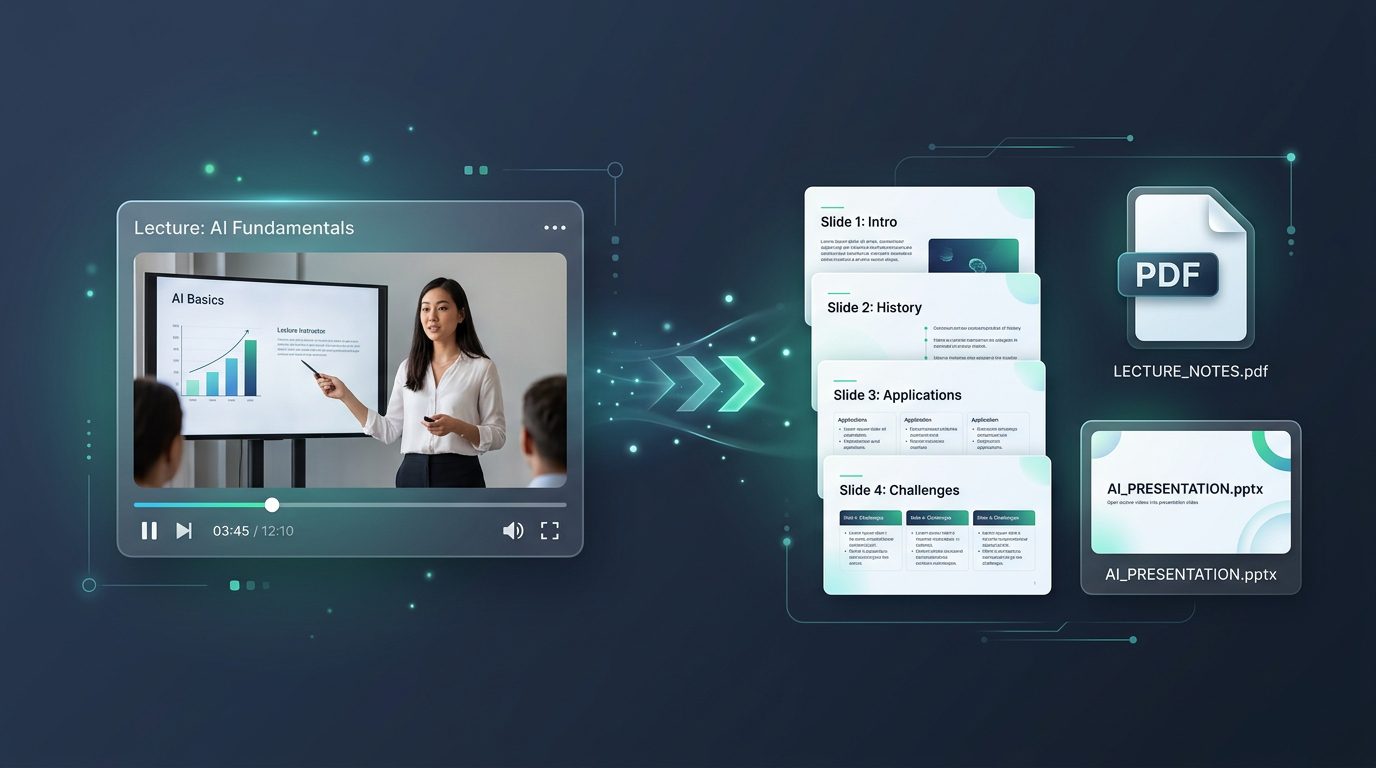
An open-source desktop tool that captures clean lecture slides from YouTube and local recordings before instructor annotations appear.
Video to Slide is an open-source desktop tool designed to automatically capture lecture slides from YouTube videos, full playlists, or local video files. By filtering out whiteboard marker strokes and isolating the earliest clean frames, it converts lecture recordings into high-resolution PNG images, consolidated PDF documents, and editable PowerPoint (.pptx) presentations. It eliminates the tedious chore of pausing videos to take manual screenshots, providing students and researchers with clean digital study materials.
Project Overview
| Property | Value |
|---|---|
| Role | Design, algorithm, development |
| Status | Open Source (Public Release) |
| Scope | Video processing, slide detection, and document compilation |
| Technologies | Python, OpenCV, yt-dlp, python-pptx, PyInstaller |
| License | MIT |
| Distribution | GitHub Release (Portable Windows, macOS, Linux) + Source Code |
Motivation and Background
Taking comprehensive notes from video lectures is traditionally a slow, repetitive process. Viewers constantly pause playback, capture screenshots, crop boundaries, and paste images into notes.
Beyond the manual friction lies a common visual problem: instructors frequently annotate slides with digital pens or colored markers immediately after a slide appears. Conventional scene-detection tools typically grab the final state of each scene, resulting in saved images cluttered with scribbles, annotations, and partial occlusions.
Video to Slide was built to resolve this practical challenge:
- Process video links or local files with a single action,
- Automatically detect and capture the initial pristine slide frame before handwriting begins,
- Filter out colored marker strokes during frame comparisons to accurately identify slide transitions,
- Compile results directly into clean PDF documents and editable PowerPoint decks.
Algorithmic Approach
As the engine scans video streams frame by frame, it applies two core computer vision heuristics:
First Clean Frame Detection
When a slide advances during a lecture, the display stabilizes briefly before the instructor begins drawing or gesturing. Once the transition is recognized, the algorithm locks onto the earliest stable frame before motion thresholds are breached. This ensures that subsequent handwritten annotations do not degrade the captured slide.
Whiteboard Marker Filtering
Vibrant marker strokes can distort conventional frame-difference calculations. The comparison pipeline isolates and filters these high-saturation strokes, distinguishing true slide transitions from local handwriting without sacrificing the quality of the underlying original image.
Key Capabilities and Formats
- Multi-Source Ingestion: Ingests individual YouTube URLs, complete playlists, local
.mp4,.mkv,.mov,.webmfiles, or entire directories of recordings in batch mode. - Versatile Output Formats:
- High-resolution individual PNG slide images,
- Merged PDF lecture notes,
- Editable PowerPoint (.pptx) presentations with slides arranged sequentially.
- Bilingual Interface: Instant one-click toggle between English and Turkish.
- Parameter Controls: Allows straightforward adjustment of motion thresholds, cropping margins, and compression quality through the desktop UI.
Cross-Platform Distribution
Video to Slide is packaged to run independently without requiring Python installations or complex environment setup:
- Available as standalone, portable executables for Windows, Linux, and macOS.
- Built with a clean, fast desktop interface.
- Executes entirely on the local processor without hosted APIs or remote cloud dependencies.
Project Status and Availability
Video to Slide is developed openly under the MIT license. Full source code, documentation, and pre-built binaries are maintained on GitHub.
📋 Related Links
🌐 LinkedIn Post: Video to Slide: Open-Source Lecture Slide Extractor
📂 GitHub Repository: github.com/muisik/video-to-slide
🔗 Related Project: Tender Tracker: Local Public Procurement Monitoring Tool
🛠️ Related Project: ContextRail: Minimum Governed Project Memory
Last updated: September 2026 | Version: 1.0