Turning Dark Data in the Field into Value with IIoT Infrastructure

The majority of industrial machine data goes unanalyzed. Transforming dark data into business intelligence without intrusive PLC modifications is achievable through edge computing.
In manufacturing facilities worldwide, vast amounts of machine telemetry vanish unanalyzed, creating widespread operational blindness. Overcoming the misconception that digital transformation requires overhauling machine lines and rewriting PLC logic, a non-intrusive approach combining passive register querying, localized edge computing, Store and Forward resilience, and PackML state modeling enables plants to convert dark data into business intelligence at the source.
The True Value of Data
A common misconception in manufacturing is viewing data collection merely as an IT project or a compliance initiative. In reality, operational telemetry is not just gigabytes of log files. Telemetry is the single objective answer to operational questions: “Is the drive motor currently straining under load?” or “Is our actual OEE 85 percent as logged manually, or is it closer to 60 percent?”
Industry research reports (including findings from Forrester, IDC, and IBM) indicate that between 60 and 73 percent of operational machine data generated across plants goes unanalyzed. Termed ‘dark data’ across industrial literature, this uncaptured telemetry leaves plant operations flying blind. Waiting until a machine breaks before intervening represents the most costly and inefficient maintenance model possible.
The actual value of data lies in breaking this reactive cycle. Establishing appropriate telemetry infrastructure enables teams to capture subtle cycle-time drifts and temperature increases days before components fail, turning unplanned stoppages into scheduled maintenance windows.
Plant Reality: Brownfield Equipment and Data Silos
Production facilities rarely feature homogeneous machinery sourced simultaneously from a single supplier. Instead, brownfield plants operate diverse equipment deployed across different decades: a 2005 Siemens controller operating alongside a 2012 Omron line and standalone Modbus instrumentation.
Disparate Memory Architectures
Vendor-specific register architectures deepen this fragmentation. Siemens platforms structure process variables within Data Blocks (DBs), whereas Omron allocates telemetry across CIO, Work Area, or Data Memory regions.
Modbus RTU Constraints
Legacy Modbus RTU installations rely on sequential polling cycles where query latency scales with node count. Low baud rates, checksum discrepancies, and packet drops compound communication instability.
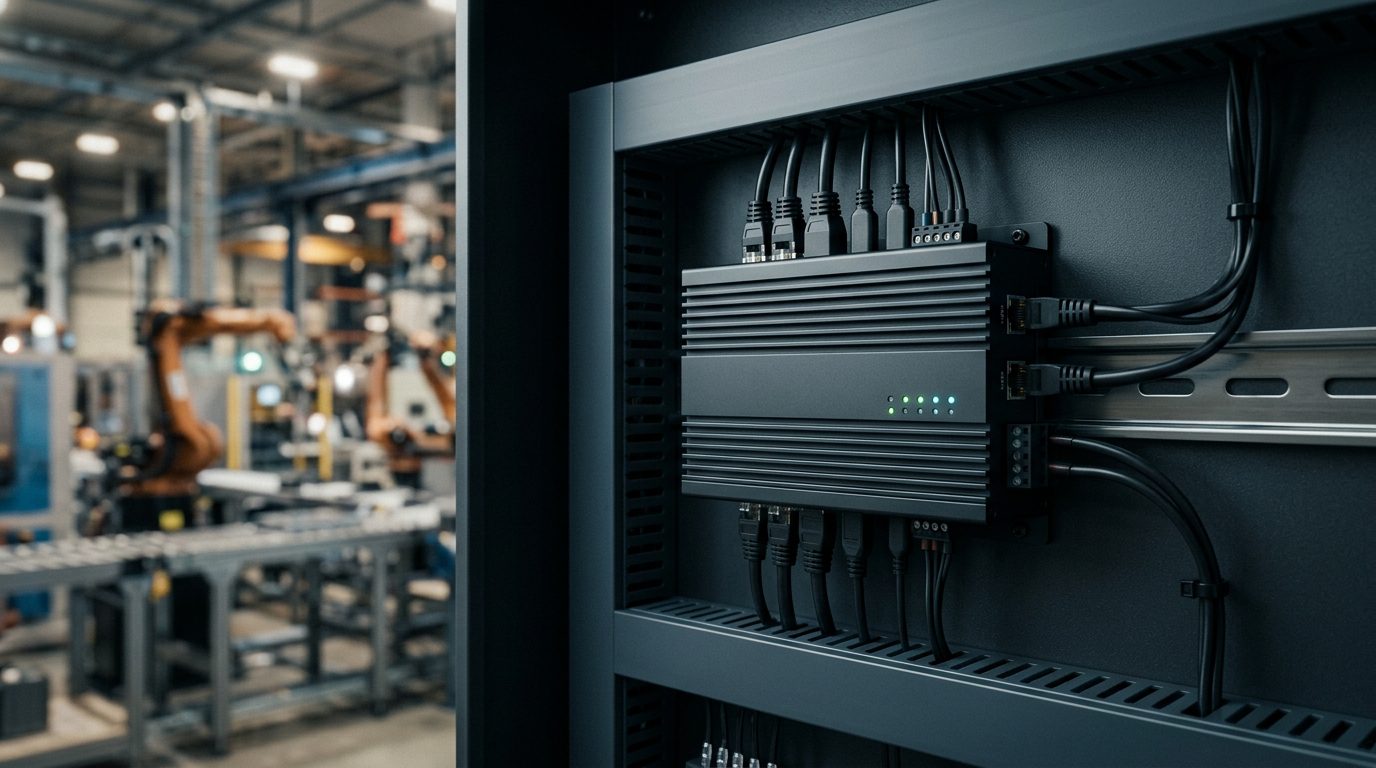
While modern architectures favor OPC UA, the majority of installed brownfield controllers lack native support. Deploying an industrial edge gateway inside the control enclosure bridges legacy protocols without touching line wiring.
Non-Intrusive Telemetry Ingestion
The most prevalent hesitation surrounding telemetry collection is the belief that PLC ladder logic must be rewritten. Modifying validated production code introduces unacceptable operational risks.
Active Push Blocks and Passive Read Architecture
Traditional integrations inject custom communication function blocks into the controller runtime, forcing the PLC to push telemetry externally. This consumes PLC cycle overhead, risks scan-time overruns, and voids OEM warranties.
A passive read architecture circumvents these issues. The external edge node queries standard industrial registers through non-intrusive read-only requests. Active program routines remain untouched. On Siemens S7-1200 and S7-1500 controllers, disabling optimized block access and permitting standard PUT/GET communication is managed via controller configuration parameters without altering core ladder logic. Provided that communication interfaces and security permissions allow external polling, passive read-only telemetry extraction can be sustained safely. Omron platforms permit direct memory queries by default.
Edge Computing: Ingestion and Processing at the Source
A single high-frequency vibration sensor can sample thousands of points per second. Forwarding raw telemetry streams directly to cloud endpoints rapidly congests network bandwidth and escalates hosting costs into an unmanageable data tsunami.
Edge computing addresses this by processing data at the source:
- Deadband Filtering: Stationary, unchanging data is dropped locally. For temperature signals, records are only dispatched when delta thresholds (such as 0.5°C) are breached, reducing network load by 60 to 80 percent.
- Micro-Batching: High-frequency readings are summarized into periodic statistical envelopes (minimum, maximum, mean) over configurable windows, generating a single clean record from hundreds of raw samples.
- Actionable Intelligence: Replacing hundreds of thousands of noisy data rows with an actionable notification: “Drive Motor 3 Mechanical Degradation Detected.”
Store and Forward: Continuous Data Resilience
When internet connectivity drops, data collection must continue unabated. Once the uplink is restored, data must synchronize chronologically without gaps.
Three-Tiered Buffering Architecture:
- Volatile RAM Buffer: Telemetry is initially ingested into high-speed memory.
- Local Embedded SQL: Utilizing WAL architectures, data is written to solid-state storage with millisecond timestamps, ensuring survival across unexpected power losses.
- Circular FIFO Queue: If disk limits are reached, circular buffering overwrites the oldest entries to prevent device exhaustion. When the connection re-establishes, records drain chronologically.
Within the bounds of local disk storage capacity, records are retained until an explicit delivery acknowledgment is returned by the central endpoint, safeguarding data integrity across prolonged network outages.
PackML: The Universal Language of Machinery
Interpreting raw integer status registers across competing PLC brands is inefficient. The OMAC PackML standard provides a unified state machine for industrial machinery:
- EXECUTE: The machine is actively producing within specification.
- SUSPENDED: The machine is healthy but paused due to external bottlenecks: upstream starvation or downstream conveyor blockages.
- HELD: Paused due to manual operator actions (material loading, inspection).
- ABORTED: Physical machine stoppage triggered by safety interlocks, overloads, or component failures.
Distinguishing these states fundamentally corrects OEE analysis: Suspended and Held states highlight operational and line-balance inefficiencies, while Aborted states indicate genuine machine failures.
Sensorless Predictive Maintenance
Predictive maintenance does not always demand expensive thermal cameras or complex machine learning models. Three effective deterministic heuristics can be executed directly at the edge:
- Starting State Duration Trends: If the time taken to complete the PackML Starting sequence increases from 25 to 50 seconds over several weeks, mechanical friction in servo slides or pressure drops in pneumatic circuits are developing.
- Aborted and Held Frequency Analysis: When manual Held events remain steady while Aborted incidents trend upward, mechanical wear is exceeding operational limits, cleanly distinguishing operator actions from hardware fatigue.
- Execute Performance Degradation: Comparing instantaneous production speed against rated design speed uncovers pneumatic lag and drivetrain drag well before thermal limits trip.
Servitization and New Revenue Channels
For machine manufacturers, this architecture unlocks high-margin recurring business models:
- Telemetry Dashboards as a Service: Tiered visibility granting operators production overviews while providing OEM engineering deep diagnostic access.
- Service Level Agreements: Shifting from one-off machine capital expenditure to continuous condition monitoring contracts.
- Warranty Verification: Objective telemetry proving whether machinery was operated outside agreed temperature, load, or speed parameters.
Conclusion
Edge computing and IIoT infrastructure represent the foundation of operational excellence in manufacturing. Where existing controller interfaces permit non-intrusive polling, industrial plants can bridge data silos safely and economically without altering runtime control logic or incurring excessive cloud bandwidth overhead.
Transforming dark data into tangible value does not require replacing factory machinery; it simply requires the right architecture to listen to it.
📚 References
Forrester Research (2016). The Forrester Wave: Big Data Hadoop Cloud Solutions. Forrester Research.
IDC (2020). Data Creation and Storage Technologies: The Digitization of the Operational World. International Data Corporation.
IBM (2020). Extracting Business Value from Industrial IoT and Big Data Telemetry. IBM White Paper.
OMAC (2021). PackML Packaging Machine Language Standard, ISA-TR88.00.02. Organization for Machine Automation and Control.
IEC (2013). IEC 62264-1: Enterprise-Control System Integration — Part 1: Models and Terminology. International Electrotechnical Commission.
📋 Related Links
📂 Data from Field to Cloud and IIoT: MCA World Fair 2026
🔗 Hardware Architecture to Overcome the IT/OT Barrier: Secure Remote Service for Machine Builders