Context and Localization in Automation: HMI Translation Failures

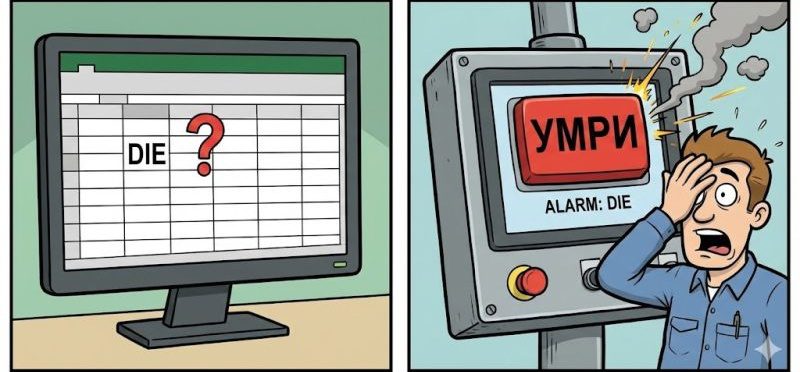
Localizing a product is not looking up words in a dictionary; it is integrating language into the machine’s operational reality and field usage scenarios.
In a past project, I was responsible for the interface translations of an industrial wire drawing machine manufactured for the iron and steel sector. Across thousands of spreadsheet rows with Turkish, English, and Russian columns, words were placed arbitrarily without machine schematics, UI placement, or context. This article examines why technical translations without operational context turn into a game of Russian Roulette on the plant floor.
Thousands of Spreadsheet Rows and Context-Free Translation
On my desk sat an Excel sheet of thousands of rows consisting of Turkish, English, and Russian columns. Words arbitrarily dumped into cells just by hitting an automated translation tool… No schematics of the machine, no indication of where the button sits on screen, and zero context on whether a given string represented an action, a state, or an industry-specific component.
That was the moment I realized: context-free translation is like playing Russian Roulette.
From Die Calculation to Death Calculation
Why? Consider the isolated noun “DIE” in a wire drawing machine’s HMI spreadsheet. In manufacturing, a “die” is the shaped tool or nozzle through which metal wire is pulled. Without operational context or part drawings, a translator or automated tool maps “die” to human mortality. On field screens, what was meant to be “Die Calculation” appeared in local languages as literal translations of “Death Calculation” (such as Turkish “Ölüm Hesabı” or Russian “Расчет смерти”)—causing instant confusion and alarm on the factory floor.
Industrial user interfaces are not decorative surfaces; they form the cognitive bridge between the operator and high-inertia physical processes. When linguistic localization is detached from physical machine context, the HMI shifts from an operational aid into an active liability.
From Humorous Glitches to Safety Hazards
Such errors may appear humorous at first glance, but in industrial operations, the consequences extend far beyond comedy:
- Emergency Response and Panic: During equipment trips or alarms, operators must interpret screen messages within seconds. Bizarre or alarming phrases disrupt mental models, delay response times, or provoke incorrect manual interventions.
- UI Breakage and Text Truncation: A concise four-letter English command can easily expand to twenty characters in German or Russian. When translators lack pixel bounds and UI context, text overflows buttons, overlaps adjacent indicators, or gets clipped entirely.
Provide Context, Not Just Isolated Strings
Therefore, in any engineering project, never just send a raw string list to translation teams and expect a reliable interface. Give them screen captures, an approved technical glossary, and clear operational context regarding what the machine actually does.
Otherwise, even multi-million-dollar automated lines fail to establish dependable communication with operators, breeding operational friction and avoidable safety hazards.
📚 References
Nielsen, J. (1994). Usability Engineering. Morgan Kaufmann.
Cooper, A., Reimann, R., Cronin, D. & Noessel, C. (2014). About Face: The Essentials of Interaction Design. John Wiley & Sons.
📋 Related Links
🔗 Engineering Ego and Field Reality: Why Elegant Architectures Fail at Customer Bottlenecks
🔗 Foundation Models and Field Physics in Predictive Maintenance: Why Time Series Forecasting Cannot Replace Failure Physics