Deterministic Behavior: Real Time, Real Results

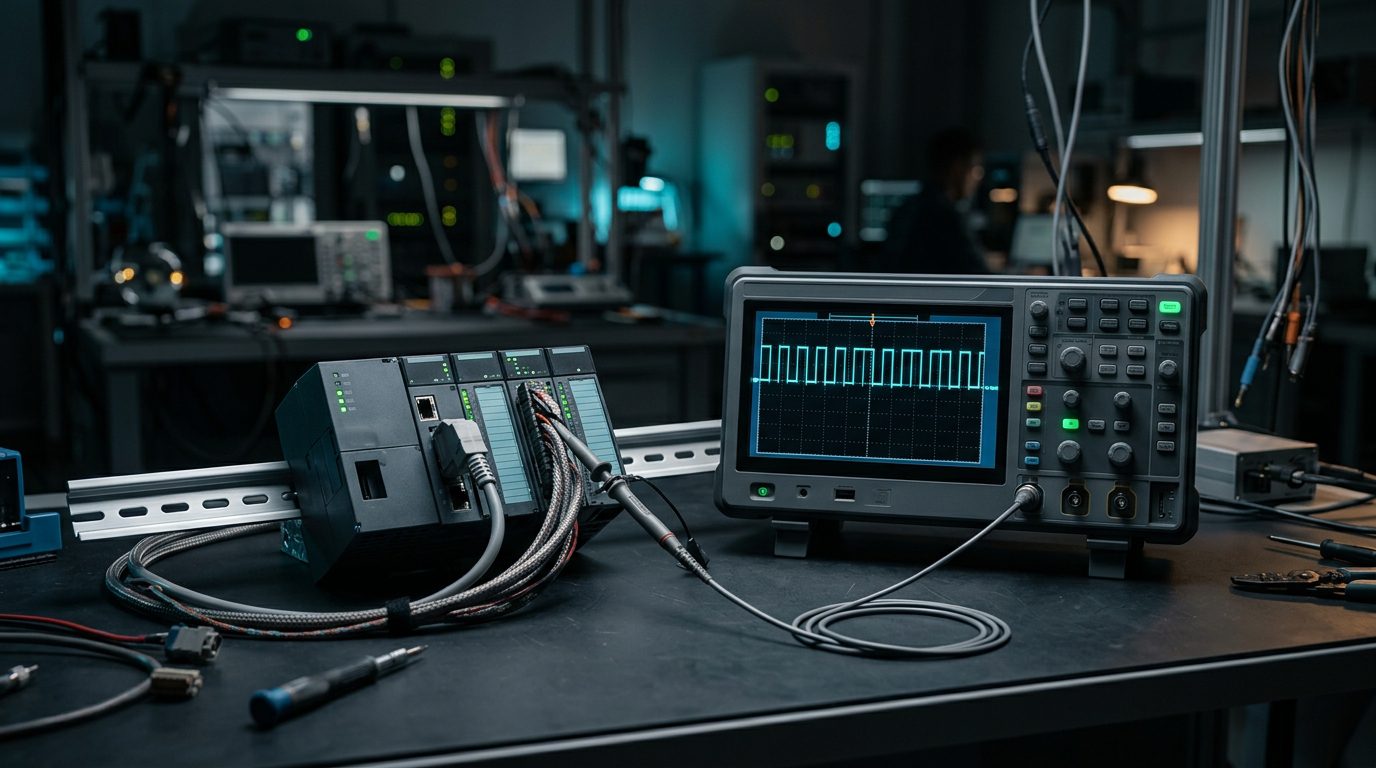
In industrial control systems, excellence is defined not by raw processor speed, but by the ability to guarantee bounded execution limits and predictable timing determinism under all operating conditions.
In critical industrial automation architectures, a common engineering misconception confuses raw computational throughput with deterministic behavior. While general-purpose operating systems on modern industrial PCs can execute billions of instructions per second, they operate on a ‘best-effort’ scheduling philosophy that introduces millisecond-scale latency spikes due to non-deterministic interrupt handling. Conversely, classic Programmable Logic Controller (PLC) architectures enforce strict scan-cycle discipline that guarantees execution boundaries. This analysis examines the architectural divergence between execution speed and determinism, details PLC scan loops, and demonstrates how Real-Time Operating Systems (RTOS) bridge high-throughput compute with sub-millisecond control determinism.
The Fundamental Divide Between Raw Speed and Determinism
One of the most persistent misconceptions in industrial computing is treating “fast systems” and “real-time systems” as interchangeable concepts.
Achieving an average execution latency of a few hundred microseconds does not qualify a computing platform as an industrial real-time system. The defining benchmark of a real-time system is not peak throughput, but deterministic behavior.
Determinism denotes the property whereby the timing and state transitions produced in response to a given input are strictly bounded by mathematical guarantees. Stated simply:
- A process that completes on average in 1 millisecond, but occasionally spikes to 50 milliseconds due to background operating system tasks, is fast, but entirely non-deterministic.
- A process that completes reliably in exactly 10 milliseconds under all operational loads without exception is deterministic, regardless of whether its average duration appears slower on paper.
On a high-speed bottling line, inside a railway signaling interlocking loop, or within a closed-loop hydraulic press controller, an isolated 40-millisecond delay results in mechanical collisions, sheared tooling, or triggered emergency stops. In field engineering, performance in the best-case scenario is irrelevant; what matters is the mathematical upper bound in the worst-case scenario.
The PLC Architecture: Strict Scan Cycle Discipline
Programmable Logic Controllers (PLCs) have remained the unchallenged backbone of factory automation for decades. This longevity does not stem from gigahertz-level clock rates, but from the rigorous predictability of their scan cycle discipline.
A standard PLC firmware runtime executes three discrete phases sequentially in an endless loop:
- Input Scan (Process Image Inputs – PII): Physical digital and analog inputs are sampled synchronously and latched into internal memory.
- Logic Execution: The user control application runs sequentially from top to bottom against the static latched memory image. Fluctuations on physical pins during this phase do not alter internal program execution.
- Output Scan (Process Image Outputs – PIQ): Computed state variables are written simultaneously to physical output modules.
This sequence guarantees strict cycle-time stability. If a PLC cycle is configured for 2 milliseconds, hardware watchdog timers enforce that window. If a computational routine exceeds the allocated window, the runtime immediately faults into a safe state. This deterministic cadence makes PLCs indispensable for safety-critical logic.
The Achilles Heel of General-Purpose Operating Systems
Conversely, modern PC-based industrial controllers leverage multi-core x86/ARM architectures and gigabytes of memory, offering immense raw computational power. For machine vision inspection, high-dimensional motion planning, and edge machine learning inference, this processing capacity is essential.
However, standard desktop or enterprise server operating systems (such as generic Windows or mainline Linux kernels) are engineered around a “best-effort” execution paradigm. Their design prioritizes average throughput, UI responsiveness, and fair CPU time-sharing across arbitrary processes:
- Time-Sharing Schedulers: The kernel dynamically redistributes CPU slices among background services, network daemons, virtual memory paging, and user processes.
- Uncontrolled Interrupt Latency: Peripheral events (such as USB bus updates, network packet bursts, or disk I/O flushes) trigger asynchronous hardware interrupts that preempt active execution loops.
- Timing Jitter: While a control loop may target a nominal 1-millisecond period, actual execution varies wildly between 0.8 milliseconds and 3.5 milliseconds. This timing variance is termed jitter.
The table below contrasts the fundamental architectural trade-offs:
| Parameter | Traditional PLC | General-Purpose PC (Standard OS) |
|---|---|---|
| Primary Design Philosophy | Guaranteed determinism and bounded execution | Maximum average throughput and flexibility |
| Timing Behavior | Hard cycle times with microsecond-level variance | Best-effort execution with high latency jitter |
| Interrupt and Task Priority | Hardware-enforced, strictly deterministic priority | Dynamic time-slicing and asynchronous preemption |
| Computational Capacity | Constrained to boolean logic and sequential control | Extensive vector processing and data analytics |
| Critical Fault Behavior | Watchdog timeout triggers immediate safe-state | Blue screen, kernel panic, or unhandled thread lock |
Bridging the Chasm with RTOS: Disciplining Raw Compute
Must engineering teams sacrifice the timing guarantees of a PLC when leveraging the processing capacity of an industrial PC?
This architectural dilemma is resolved by Real-Time Operating Systems (RTOS). Platforms such as Linux patched with PREEMPT_RT, VxWorks, QNX, or industrial runtimes like Beckhoff TwinCAT embed a microsecond-deterministic kernel directly beneath or alongside the general-purpose environment.
An RTOS runtime enforces three fundamental execution guarantees:
- Preemptive Priority Scheduling: Time-critical tasks (such as position loop closures) maintain absolute CPU preemption. Irrespective of network load or background filesystem writes, the real-time thread preempts all other activity instantly.
- Bounded Kernel Invocations: System call latencies and interrupt dispatch times are deterministic. Dynamic heap allocation is avoided; process memory is locked in physical RAM at startup to eliminate runtime page faults.
- Minimal Jitter: Execution timing variance is collapsed from milliseconds down to single-digit microseconds.
Consequently, standard PC hardware is disciplined into a deterministic execution engine. Engineers can run heavy computer vision and complex analytics while simultaneously guaranteeing synchronized multi-axis servo trajectories within a bounded microsecond jitter window.
Conclusion: Engineering for Guaranteed Bounds, Not Hardware Hype
When architecting an industrial control platform, the primary question is not “Which controller provides more gigahertz or lower unit cost?” The essential architectural inquiry is:
What specific response time, within what variance boundary, must this system mathematically guarantee?
If an application tolerates hundreds of milliseconds of jitter, a standard operating system or basic microcontroller is entirely sufficient. However, if preventing kinetic collisions, containing exothermic reactions, or commanding high-speed emergency braking is non-negotiable, selection is dictated not by technology marketing, but by the mathematics of determinism.
Architecture is dictated not by hardware specifications, but by the physical limits a system is obligated to guarantee.
📚 References
IEC 61131-3 (2013). Programmable controllers: Part 3: Programming languages. International Electrotechnical Commission.
Giorgio C. Buttazzo (2011). Hard Real-Time Computing Systems: Predictable Scheduling Algorithms and Applications. Springer Science & Business Media.
Jane W. S. Liu (2000). Real-Time Systems. Prentice Hall.
IEEE Std 1003.1b (1993). Standard for Information Technology: Portable Operating System Interface: Realtime Extension.
📋 Related Links
🔗 Fieldbus Integration in Safety-Critical HMI Systems
🔗 Without OT at the Table, Defense Begins Incomplete: Critical Infrastructure Blindspot
📄 Secure Remote Service Architecture for Machine Builders
Last updated: April 2026 | Version: 1.0