Service and Diagnostic Operations Architecture for Consumer Electronics and Wearables


Engineered an end-to-end service and diagnostic operations architecture for a consumer electronics and wearable ecosystem across 4 brands and 13 models, establishing structured triage workflows, error code taxonomy, and standardized functional test protocols.
A centralized service and diagnostic operations architecture was engineered to support the after-sales technical operations for a 140,000+ unit consumer electronics and wearable accessory ecosystem across 4 global brands and 13 product models in Turkey. All procedures—from fault triage to root-cause reporting—were standardized using Standard Operating Procedures (SOPs), a 24-category error code taxonomy, and structured functional test protocols, successfully transitioning operational tracking from unstructured individual practices to a scalable quality governance model.
Project Portfolio
|
Parameter |
Value |
|---|---|
|
Category |
Process Digitalization & Service Architecture |
|
Delivery Type |
Operational process design (SOP) |
|
Scale |
140,000+ Distributed Product Ecosystem, 13+ Models, 4 Brands |
Current Situation and Challenge
Context: Technical support and warranty operations supporting a consumer electronics and wearable accessory ecosystem comprising 4 brands, 13 product models, and a 140,000+ unit distributed market volume.
Critical Problems:
|
Problem |
Impact |
|---|---|
|
Data Pollution |
Inconsistent and subjective fault descriptions such as “Won’t turn on”, “No power”, or “Dead” entered for identical technical issues prevented systematic root-cause analysis. |
|
Lack of Test Standard |
The absence of objective test procedures left verification to subjective assessments, increasing device bounce rates. |
|
Reporting Chaos |
The legacy database structure was functionally unsuitable for basic analytics, forcing 1,500+ lines of agonizing manual editing per cycle. |
|
Logistics Waste |
Completely unacceptable 5-7 day pipeline delays frequently resulting from raw product transportation between the technical center and main warehouse. |
Highlighted Risk Models:
|
Model Group |
Volume |
Service Rate |
Status |
|---|---|---|---|
|
Neckband Type TWS |
Low |
16% |
🔴 Critical |
|
Compact TWS Model A |
Low |
14% |
🔴 Critical |
|
High Volume TWS |
High |
3% |
⚠️ Volume margin risk |
Solution Architecture and Action Plan
Architectural Approach: The pre-existing operational chaos was rigorously disciplined and industrialized through the abrupt establishment of strict data and process governance rules.
Greenfield Operations Center Setup
A physical technical operations center infrastructure was established within the company’s own primary facility:
Procured Setup Equipment:
- Ampere-metered diagnostic charging units
- Calibrated multimeter measurement devices
- Acoustic decibel precision meters
- Antistatic workstation cloths, inspection cameras, tool bags, barcode scanners, and sustained consumables
Total Investment: ~$750 / Workstation Set
Error Code Taxonomy Implementation
Subjective free-text fault descriptions were prohibited. Highly standardized hierarchical error codes were designed containing 3 main vectors and 24 root categories:
Predefined Error Codes Structure Example:
X: Fault Source
0 . No Issue Found
1 . Under Warranty
2 . Out of Warranty
Y: Fault Type
0.0 . No Issue Found
1.1 . Not Working / Totally Unresponsive
1.2 . Bluetooth Connection Problem
1.3 . Battery / Charging Problem
1.4 . Acoustic Sound Problem
1.5 . Mechanical and Core Material Problems
1.6 . Special Customer Satisfaction Actions
2.6 . Out of Warranty Exclusion
Z: Fault Detail
E01 - Battery Cell Failure
C03 - Bluetooth Connectivity Flaw
H12 - Severe Physical Damage voiding warranty
N00 - No Issue Verified
Execution Strategy:
- Each physical device was hard-labeled with a distinct 3-letter barcode tag.
- The fundamental evaluation and triaging process was dramatically accelerated.
- Highly specific customer report output texts were auto-generated matching each unique fault code.
Formulation of Standard Routine Test Procedures
A comprehensive diagnostic test algorithm containing ordered 45+ steps was formally instituted for each product group:
Test Protocol Flow Architecture Example:
1 . Sequential removal of protective packaging tapes
2 . Mandatory pre-test directly correlating to the customer complaint
3 . Severe abuse inspection (chemical cleanliness check)
4 . Macro physical damage inspection (deep scratches, dents, structural cracks)
5 . Manufacturing-sourced microscopic physical defect evaluation
6 . Circuit board burn/melt/overheating smell inspection
7 . Primary charging process (30min lock) and continuous current stability check
8 . Case-to-earphone pin charge contact validation test
9 . Handshake & Bluetooth pairing test
10 . Sustained sound playback test (calibrated decibel measurement)
11 . Microphone input/active call loop test
12 . Load battery life depletion test (15min playback maxing a rigid 10% decrease expectation)
13 . Automatic shutdown / smart case hibernation test
Error Code Logic (X.Y.Z System):
|
Code |
Meaning |
Translation Example |
|---|---|---|
|
0.0.1 |
No Issue Found |
Fully normal operation verified |
|
1.1.1 |
Electronic Failure |
Zero response registered in left earphone |
|
1.2.1 |
Pairing Problem |
Disconnected sync between TWS earphones |
|
1.3.1 |
Charging Issue |
Earphone module flatlining, not charging |
|
1.4.1 |
Sound Problem |
no acoustic playback sound |
|
1.5.1 |
Physical Component |
Metal pin contact problem |
|
2.0.1 |
Out of Warranty |
Verified user neglect / Abuse |
|
2.0.2 |
Out of Warranty |
Critical physical hardware damage |
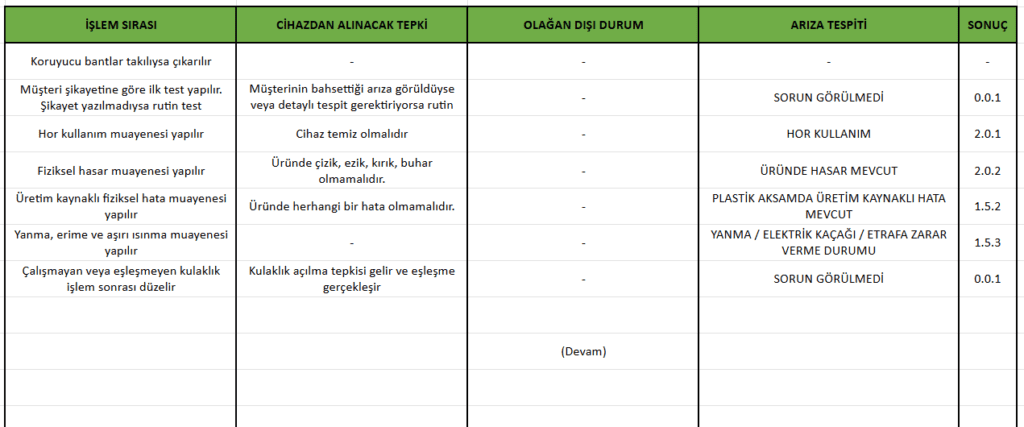
📸 Visual 1: Routine Standard Test Procedure Document Extract – 45+ Step Algorithm and Binary Decision Tree
New Reporting Architecture
The unstructured legacy data schema was restructured to align with the new process architecture and root-cause tracking requirements:
Accessible Primary Data in the New Table Structure:
- Exact failure rates (indexed model-based)
- Hardware failure sources (indexed error code-based)
- Precisely tracked service Entry/Exit timestamps
- Granular customer identity information
- Final device disposition state resolution
Weekly Governance System: Identified entry errors and minor deficiencies were promptly audited and corrected to maintain an uncompromised blanket of data integrity.
Results and Operational Gains
Operational and Diagnostic Metrics
The implementation of the 24-category error code taxonomy and 13-step functional test procedures brought full measurability to service operations. Initial diagnostic analyses revealed that approximately 37% of incoming warranty returns were categorized as “No Fault Found” (NFF). By establishing objective triage criteria, structured intake inspection, and frontline technical guidance, these recurring non-fault returns were effectively brought under control, significantly reducing turnaround times and unnecessary reverse-logistics overhead.
Core Operational Gains
|
Gain Vector |
Impact Detail |
|---|---|
|
Scalable Architecture |
An extreme 140,000 hardware device volume immediately became manageable without triggering paralyzing additional labor costs via pure standardized logic. |
|
Executive Analytical Competence |
The haunting question of “Which fault type is chronic in which model?” became permanently answerable for the C-level board with a single interface click. |
|
Chronic Anomaly Identification |
Anomalous “temporary fault” patterns falsely reported in TWS models were structurally identified as deeply chronic manufacturing flaws. |
|
L1 Boundary Filtering |
Supported by extensive customer service technical training, “no fault found” (NFF) returns previously polluting the service center were blocked and minimized at the source stage. |
Major Problem Pattern Discovery
Critical operational anomalies were pre-emptively detected leveraging the governed data:
Core Finding: A disproportionate number of “No Fault Found” tickets were recorded for a high-volume TWS model → Statistical anomaly analysis demonstrated that standard intake reports failed to capture intermittent issues that had become chronic hardware failures → The operational warranty policy was promptly revised at the management level to address root causes systematically.
📋 Related Links
🔗 Project Card: VoC Analytics and Critical Quality Crisis Management
🔗 Project Card: L1/L2 Support Architecture and Knowledge Management
Last update: January 2026 | Version: 1.0
Last updated: January 2026 | Version: 1.0