Voice of Customer Analytics and Critical Quality Crisis Management in Mobile Ecosystem


Unstructured consumer feedback data was transformed into actionable operational intelligence for a global mobile OEM, isolating chronic hardware defects and enforcing warranty compensations.
In the Turkey operations of a global mobile technology manufacturer, unstructured technical data from large-scale end-user requests was transformed into actionable strategic insights through a newly established quality intelligence system. Through this end-to-end system, chronic hardware crises developing silently in specific series such as screen separation and motherboard failures were diagnosed proactively. When after-sales cost for the affected series passed the 2% internal threshold used in that operation, the findings supported a structured escalation to the manufacturer’s headquarters.
Project Portfolio
|
Parameter |
Value |
|---|---|
|
Category |
Quality Assurance & Crisis Management |
|
Delivery Type |
Data Mining, Risk Analysis & Strategic Vendor Management |
|
Scale |
~60,000 Mobile Devices, 8 Different Models |
Current Situation and Crisis
Context: Tens of thousands of active mobile devices dispersed across the Turkish market, and a relentless daily influx of thousands of complex end-user requests congesting the Technical Operations Center.
Problem: Far beyond ordinary physical damage cases, a systemic crisis severely threatening brand reputation and the distributor’s financial stability was silently escalating:
|
Problem |
Detail |
|---|---|
|
Data Noise |
Critical manufacturing defects were buried amidst thousands of simple user-generated requests. |
|
Structural Integrity Loss |
Screens spontaneously separating from internal frames and aggressive ghost touch anomalies multiplying within specific batches. |
|
Blind Spot |
The Global R&D team interpreting tangible field increments in Turkey merely as “isolated incidents” rather than structural flaws. |
|
2% Threshold |
The warranty expenditure budget continuously exceeding the final sustainable risk threshold limits. |
Action and Solution Architecture
Architectural Approach: Instead of combating the crisis reactively model by model, a 3-layered data and negotiation architecture was formulated that mathematically and proves the root cause of the syndrome at a macro scale.
Data Classification and Triage
The operational data was purified from surrounding noise. All end-user requests were segmented by SKU and cleanly divided into two predominant tracking datasets:
Critical Dataset A:
- Motherboard failures sourced from manufacturing defects
- Assembly-based screen disassociations and core sensor losses
- Sudden death syndrome chain reactions
Secondary Noise Dataset B:
- User-sourced functional and cosmetic errors
- Logistics and conventional infrastructure inquiries
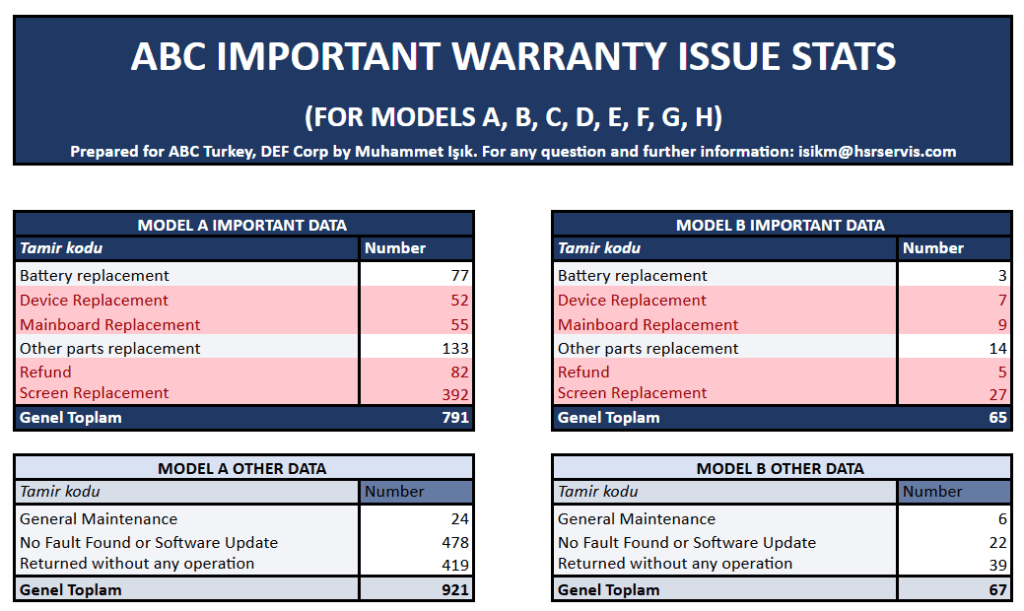
📸 Visual 1: Data Classification Table Example
Pattern Recognition and Root Cause Analysis
Execution analysis on the isolated Critical Dataset revealed:
- Screen separations in targeted models were structurally identified as fabrication adhesive insufficiency, ruling out user error.
- An absolute tight correlation of software freezing issues in one unique series synchronously linked with a specific OTA update deployment.
- Defective device serial numbers were programmatically matched with factory production dates, flawlessly enabling a comprehensive “bad batch” supply isolation.
Critical Findings by Model:
|
Model Group |
Failure Rate |
Critical Problem |
|---|---|---|
|
Series A |
21%+ |
Screen separation, motherboard |
|
Series B |
14% |
Screen + Security Lock |
|
Series C |
9% |
Sudden Death Syndrome |
|
Series D |
5% |
General screen problem |
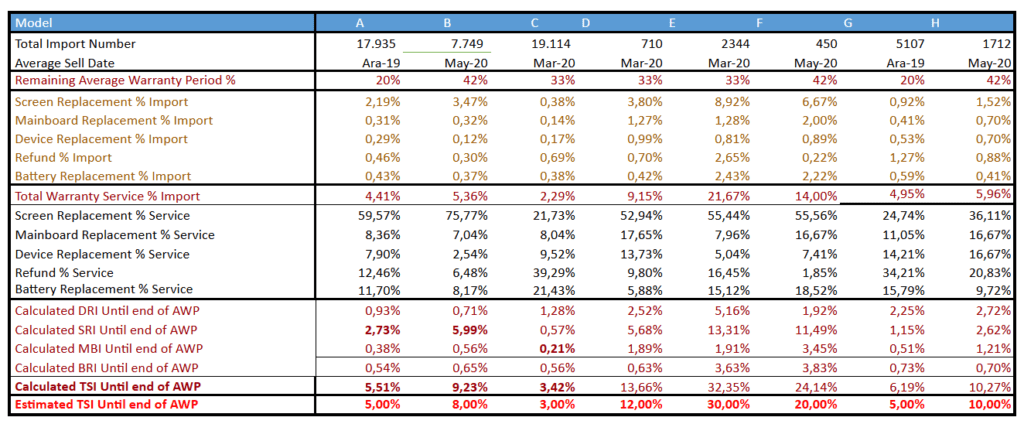
📸 Visual 2: Model-Based Failure Density – Service report table
Strategic Escalation and Financial Evidence
The prepared technical hardware analysis was strategically converted into the universal language of C-level management and the global manufacturer: financial metrics. Instead of a standard reactive technical support mechanism, a formal “Commercial Risk Notification” framework was conceptualized.
Analysis:
- Total “Unit Import Cost” versus “Operational Cost Center” profitability explicitly compared parallelly for each production series.
- It was numerically proven that warranty costs massively exceeded the 2% global norm, shifting unit profitability negatively and rendering the model financially unsustainable.
- Comprehensive series-based operational loss projection architecture built and finalized.
Action: Official defect notification declaration and high-priority status reporting dispatched directly to global headquarters.
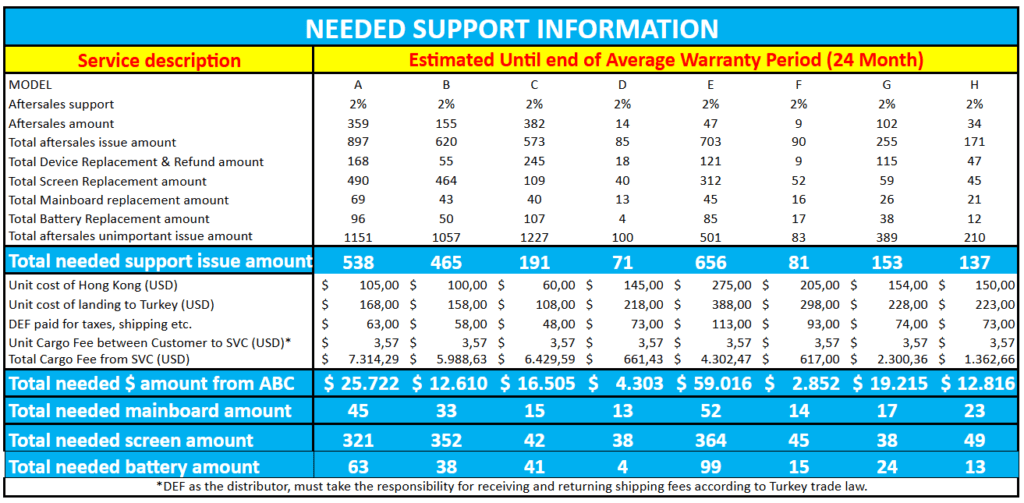
📸 Visual 3: Official crisis notification content sent to HQ
Operational Gains
Operational Transformation:
|
Gain |
Impact |
|---|---|
|
Risk Visibility |
The operational risk was transformed from an abstract engineering estimation into a transparent, quantifiable loss projection matrix for the executive board. |
|
Strategic Result |
Supported by cross-verified field data and hardware failure analyses, the structured escalation led to an agreement with the global manufacturer, validating that chronic failures were manufacturing-sourced and successfully activating contractual warranty compensation procedures. |
|
Early Warning System |
Potential defects in subsequent production allocations became detectable at early production batch stages, mitigating anomalies before they escalated into widespread field issues. |
|
Operational Transparency |
An objective, data-driven foundation was embedded within the workflow to justify stop-sale or revision decisions when critical thresholds were breached. |
📋 Related Links
🔗 Project Card: L1/L2 Support Architecture and Knowledge Management
🔗 Project Card: IoT Operations Architecture
Last update: January 2026 | Version: 1.0