Why Industrial Screens Look Outdated: The Reality of HMI Durability

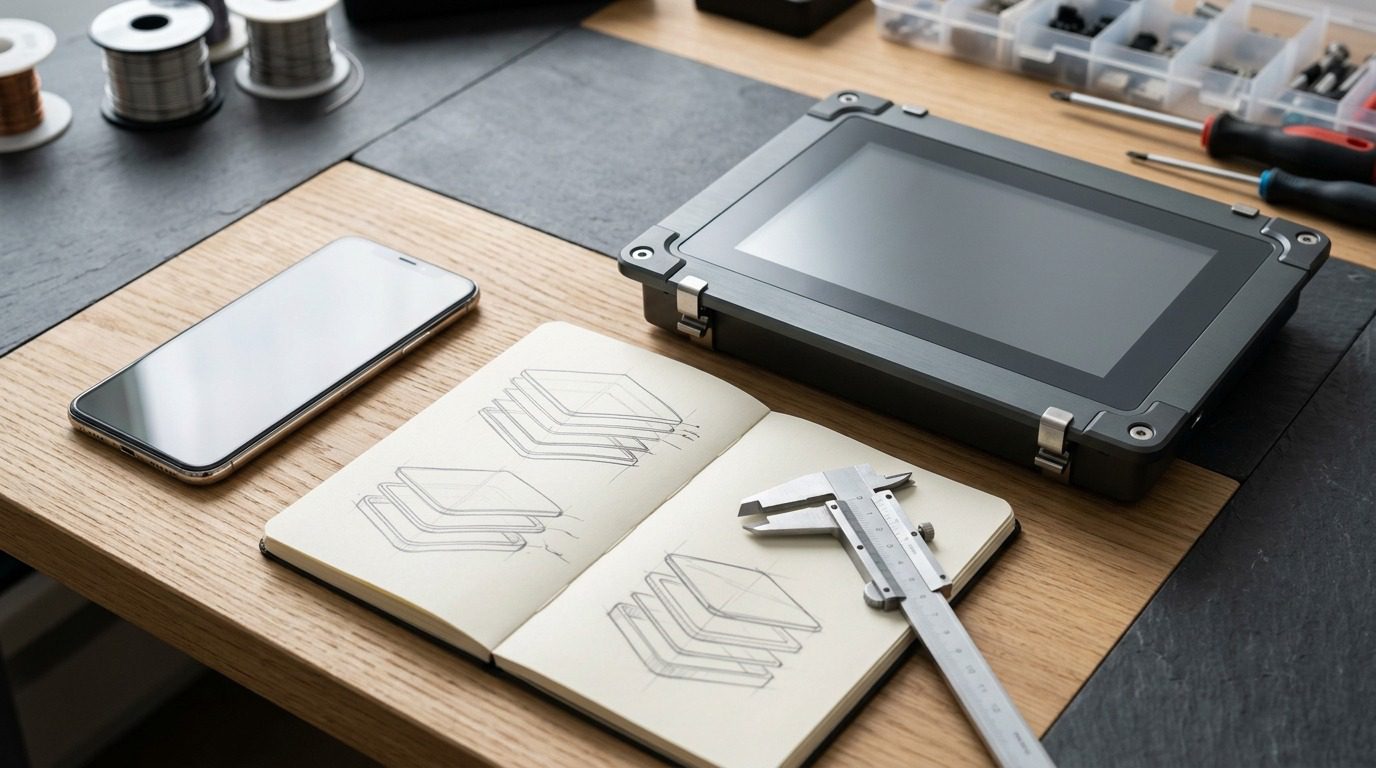
The purpose of an industrial screen is not to look attractive; it is to survive continuously under dust, vibration, and thermal stress for a decade.
To anyone accustomed to the edge-to-edge, vibrant OLED displays of modern flagship smartphones, the human-machine interface (HMI) panels governing multi-million-dollar industrial production lines can initially look clumsy and archaic. Thick industrial bezels, matte non-glare surfaces, and modest pixel densities are often dismissed by outside observers as cost-cutting measures or technological sluggishness. Yet this rugged simplicity is not an inadequacy; it represents a deliberate and uncompromising engineering design intended to prevent costly process downtime under severe shop-floor conditions. This analysis explores why industrial operator panels diverge radically from consumer electronics, examining lifecycle availability guarantees, the physics of OLED screen burn-in, deliberate air-gap layer architectures, and maintainability in the field.
Field Sustainability Over Consumer Aesthetics
Manufacturing shop floors are hostile environments for consumer electronics. An industrial installation presents heavy airborne dust, metallic shavings, oil mist, aggressive chemical solvents, relentless mechanical vibrations, and wide thermal swings ranging from below freezing to over 60 degrees Celsius. The delicate, bonded glass assemblies found in consumer smartphones will suffer delamination, touchscreen unresponsiveness, or catastrophic failure within weeks under such exposure.
Industrial TFT panels operate under an entirely different design philosophy:
- Heavy-Duty Industrial-Grade Components: Engineered with extended operating temperature ranges spanning -20°C to +70°C and LED backlight mean-time-between-failures exceeding 50,000 continuous hours.
- 7 to 10-Year Form-Fit-Function Availability: In consumer tech, hardware chassis dimensions and display aspect ratios change every single year. In industrial automation, an OEM machine builder must be able to procure an identical replacement HMI panel with exact cutout dimensions and mounting studs eight years later. Redesigning an electrical control cabinet door or porting screen resolutions causes thousands of dollars in unplanned downtime.
Static Interfaces and the Physics of Screen Burn-In
A question frequently raised by operators and clients is straightforward: Why don’t modern manufacturing plants deploy the stunning, high-contrast OLED displays used in premium mobile devices?
The answer is simple: permanent screen burn-in.
On a smartphone, displayed content is dynamic; user interfaces constantly shift, feeds are scrolled, and displays turn off after seconds of inactivity. In contrast, an industrial HMI must present the exact same static supervisory screen for continuous 12-hour shifts, days, or even weeks. Emergency stop indicators, pressure vessel level bars, pipeline flow paths, and valve symbols illuminate the exact same physical pixels at continuous high brightness.
OLED technology, which relies on organic light-emitting compounds, degrades unevenly when subjected to static high-luminance patterns. Within months, permanent ghosting and burnt silhouettes appear across the panel. In safety-critical facilities, a distorted gauge or unreadable alarm value caused by screen burn-in invites catastrophic operational error. Consequently, rugged industrial TFT displays and high-stability IPS panels with LED backlights remain the non-negotiable benchmark for plant safety.
The Intentional Air Gap and Shop-Floor Maintainability
Modern smartphones utilize optical bonding where the display panel and the outer protective glass are glued together into a single unit without a micron of separation. This creates an ultra-thin, sleek profile with rich contrast, but it introduces fatal liabilities in an industrial plant.
Industrial HMI panels feature an intentional air gap between the LCD panel and the outer resistive or capacitive touch layer. While this air gap causes slight light refraction, making the display look more diffuse and matte, it serves three indispensable operational functions:
- Thermal Expansion and Humidity Tolerance: Under wide ambient temperature swings, the dissimilar materials of the glass, touch film, and aluminum frame expand at varying coefficients. The intentional air gap absorbs mechanical shear stresses, preventing internal panel cracking.
- Impact and Shock Dissipation: Shop-floor operators do not touch screens with bare, manicured fingertips; they operate them wearing heavy work gloves, or occasionally tap them with tools or pens. The air gap acts as a mechanical shock buffer, preventing physical deflection on the outer pane from cracking the delicate liquid-crystal substrate beneath.
- Modular and Low-Cost Repairability: When a smartphone’s outer glass fractures, the entire bonded display assembly must be scrapped. On an industrial HMI, if the front protective sheet or touch layer suffers mechanical damage, technicians can replace only the front glass assembly on-site in minutes, preserving the expensive underlying LCD matrix at minimal cost.
Balancing Industrial Ruggedness with Visual Fidelity
Does industrial endurance mandate an ugly visual experience? Modern automation technology is proving that this trade-off is narrowing.
In contemporary facilities where ergonomic supervisory monitoring is paramount, chemically hardened anti-glare glass, wide-viewing-angle IPS panels, and fanless industrial panel PCs are increasingly adopted. New generations of HMI hardware successfully integrate IP66/IP69K sealing with crisp readability.
Yet the governing engineering priority remains unchanged: on an active production line, cosmetic elegance is a luxury, while unconditional survival is a necessity.
📚 References
Hollifield, B. et al. : The High Performance HMI Handbook, PAS.
International Society of Automation : ANSI/ISA-101.01-2015 — Human Machine Interfaces for Process Automation Systems.
📋 Related Links
🔗 Industrial HMI Design and Operator Experience: UI/UX Discipline on Factory Screens
🔗 Context and Localization in Industrial Automation: Translation Failures from Excel to HMI
🔗 IP Ratings vs. Industrial Reality: Why Did IP65 Ingress Liquid?
Last updated: October 2025 | Version: 1.0